
Support Small Farms – Buy Fair-Trade, Shade-Grown Coffee Beans Today
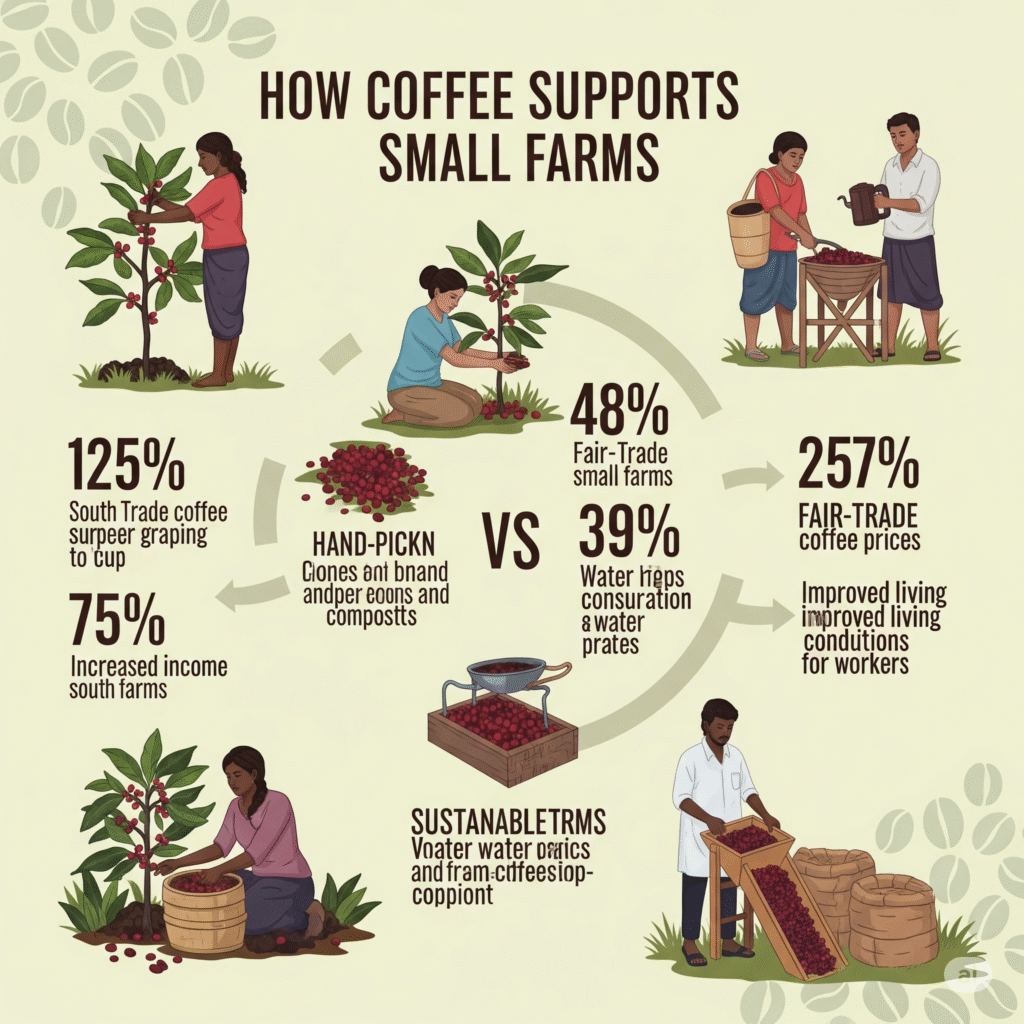
In the heart of every coffee bean lies a story — one of land, labor, and livelihood. And behind the world’s most beloved morning ritual is a network of small farms scattered across misty mountains, volcanic soils, and lush, forested regions. When you choose fair-trade, shade-grown coffee, you’re not just selecting a better cup of coffee — you’re making a statement. You’re supporting family-owned farms, preserving biodiversity, and promoting ethical trade. This is a deeper brew — one that awakens both your senses and your conscience.
☕ What is Shade-Grown Coffee?
Shade-grown coffee refers to coffee cultivated under a canopy of trees, replicating the natural environment where coffee plants originally thrived. Instead of clear-cutting forests to make way for coffee plantations, shade-grown methods preserve native trees and foster biodiversity.
✅ Key Features:
Coffee plants grow under a natural or managed forest canopy
No need for synthetic fertilizers or pesticides
Promotes bird and insect habitats
Slower bean maturation = richer flavor
🌱 Traditional vs. Modern Farming
Many mass-market coffee plantations use sun-grown techniques for higher yields. But this comes at a cost — deforestation, loss of species, and chemical runoff. Shade-grown coffee, on the other hand, emphasizes quality over quantity, yielding beans that are richer, more nuanced, and environmentally friendly.
What is Fair-Trade Coffee?
Fair-trade coffee is a certification that ensures coffee farmers receive a minimum price for their beans and an additional social premium that goes toward community development. This system is designed to empower small-scale growers, protect workers’ rights, and ensure safe, ethical labor practices.
🤝 Fair-Trade Standards Include:
Guaranteed minimum prices (protects against market crashes)
Prohibition of child labor and forced labor
Safe working conditions
Democratic decision-making for how funds are used
Gender equality promotion
When you purchase fair-trade certified coffee, you’re redirecting power and profits from multinational corporations back to local communities.
How These Practices Support Small Farms
Small coffee farms — often family-run and less than 5 acres — face enormous pressure in a global market dominated by bulk commodity prices. Without support, many are forced to sell at a loss, abandon traditional methods, or even switch to less sustainable cash crops.
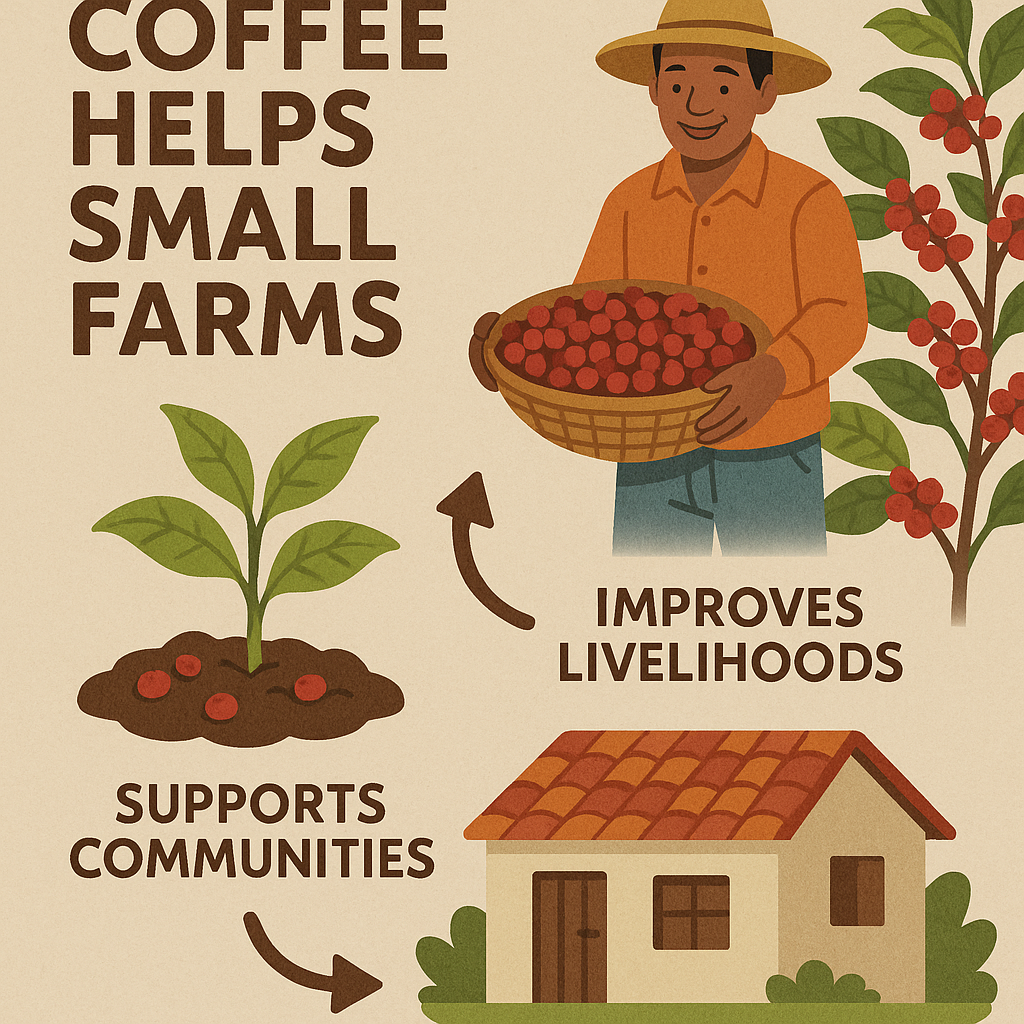
💡 The Fair-Trade Advantage:
Stability: Provides a consistent, fair price regardless of market volatility
Empowerment: Gives farmers the resources to improve their operations
Education: Supports community schools, training, and healthcare
Sustainability: Encourages organic and shade-grown methods
In short, every purchase becomes a tool for economic justice and environmental restoration.
Why Shade-Grown Coffee is Better for the Planet
Coffee is one of the most heavily traded commodities in the world, and its cultivation can have serious environmental impacts — but it doesn’t have to.
🌳 Environmental Benefits of Shade-Grown Coffee:
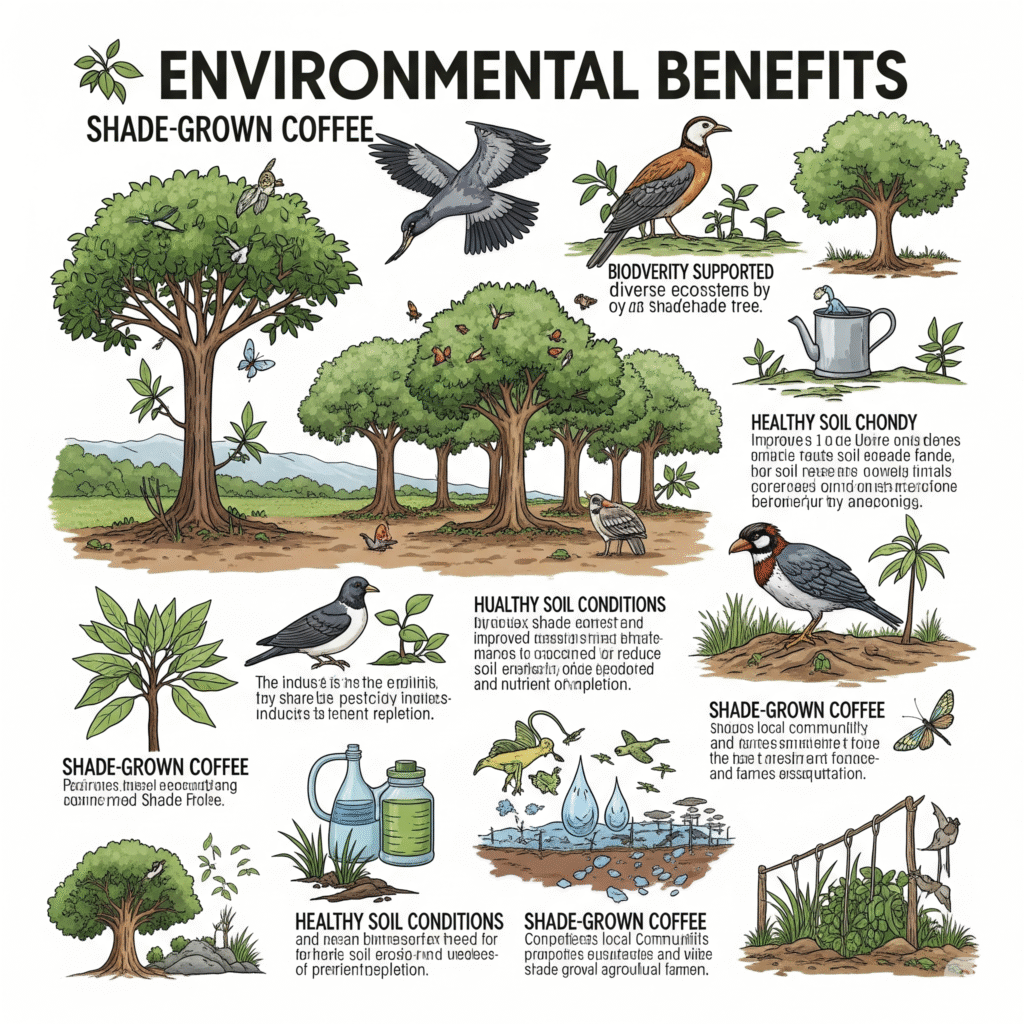
Preserves Forest Canopies: Prevents deforestation and maintains carbon sinks
Protects Wildlife Habitats: Especially important for migratory birds and pollinators
Improves Soil Quality: Less erosion and better water retention
Reduces Chemical Use: Natural pest control via biodiversity
Cools Local Climates: Trees provide temperature regulation, preventing drought
Fun fact: Shade-grown coffee farms are often referred to as “bird-friendly coffee farms” because they act as safe havens for endangered and migratory bird species.
🔬 Healthier for You, Too
Many consumers don’t realize that shade-grown, organic, fair-trade coffee is not only better for the planet — it’s also better for you.
Health Benefits:
Fewer Chemicals: Naturally grown beans mean no synthetic pesticides or fertilizers
Richer in Antioxidants: Slow-growing beans at higher elevations often contain more polyphenols
Lower Acidity: A smoother, more balanced cup that’s easier on the stomach
Fuller Flavor: Complex flavors thanks to slower maturation and rich soil
If you’re mindful of what you put into your body, choosing this kind of coffee is a natural step forward.

How to Identify Authentic Shade-Grown, Fair-Trade Coffee
Navigating labels can be tricky, especially with “greenwashing” on the rise. Here’s how to shop smart.
🏷 Look for Trusted Certifications:
Fair Trade Certified (Fairtrade International or Fair Trade USA)
Rainforest Alliance Certified
Smithsonian Bird-Friendly Certification (especially for shade-grown)
USDA Organic
🔍 Questions to Ask or Look For:
Does the brand provide sourcing information about the farm or co-op?
Is there transparency about how farmers are paid?
Are flavor profiles and processing methods clearly explained?
Pro Tip: Many ethical brands will include farm stories or photos on their packaging — a sign they’re truly invested in the people behind the beans.
🌟 Recommended Brands That Support Small Farms
If you’re ready to make the switch, here are some brands known for their commitment to fair-trade, shade-grown coffee:
1. Equal Exchange
One of the pioneers of fair-trade coffee, working with small farmer cooperatives since the 1980s.
2. Allegro Coffee
Whole Foods’ in-house coffee brand that offers organic, shade-grown, and fair-trade options.
3. Café Mam
Grown by indigenous farmers in southern Mexico, their beans are both shade-grown and 100% fair-trade
4. Peace Coffee
Minneapolis-based roaster committed to sustainability, fair wages, and organic farming.
5. Tiny Footprint Coffee
Claims to be carbon-negative; for every pound sold, they fund reforestation in Ecuador.
6. Dean’s Beans
A transparent brand that supports reforestation, clean water, and women’s health in coffee-growing communities.
Subscription Services to Try
Want coffee delivered to your door while supporting small farms every month? Check out:
Trade Coffee – Partners with ethical roasters and lets you filter for fair-trade and organic
Bean Box – Curates artisan coffee from small-batch roasters, many of which prioritize ethical sourcing
Driftaway Coffee – Offers transparency and supports farmers directly through profit sharing
Crema.co – Offers a customizable subscription with detailed sourcing info
How You Can Make a Difference
Even one purchase can support a farmer’s livelihood or preserve a patch of tropical forest. But long-term impact happens when more of us shift our habits.
📝 Tips for Being a Conscientious Coffee Consumer:
Buy from local roasters who specialize in direct trade or fair-trade beans
Educate others by sharing what you’ve learned about ethical coffee
Support retailers that prioritize sustainable sourcing (like co-ops or eco-grocers)
Ask questions when brands aren’t transparent — consumer pressure works!
Choose quality over quantity — drink better, not more
Your Cup of Coffee is a Catalyst for Change
Every cup of coffee you drink is the end result of a long, complex journey — one that starts with a farmer planting a seed. By choosing fair-trade, shade-grown coffee, you’re helping that farmer earn a living wage, preserve their land, and pass down a legacy to the next generation.
This isn’t just about taste. It’s about fairness, forests, and future generations. It’s about shifting the global coffee economy, one cup at a time.
So tomorrow morning, as you sip your brew, ask yourself:
Is my coffee just coffee… or is it a force for good?
lets go back into a little history for better understanding
🧬 The Deep Roots of Coffee: A Historical Perspective
To fully appreciate the value of fair-trade and shade-grown coffee, it helps to understand coffee’s origin story — one tied to both culture and colonialism, labor and land, tradition and transformation.
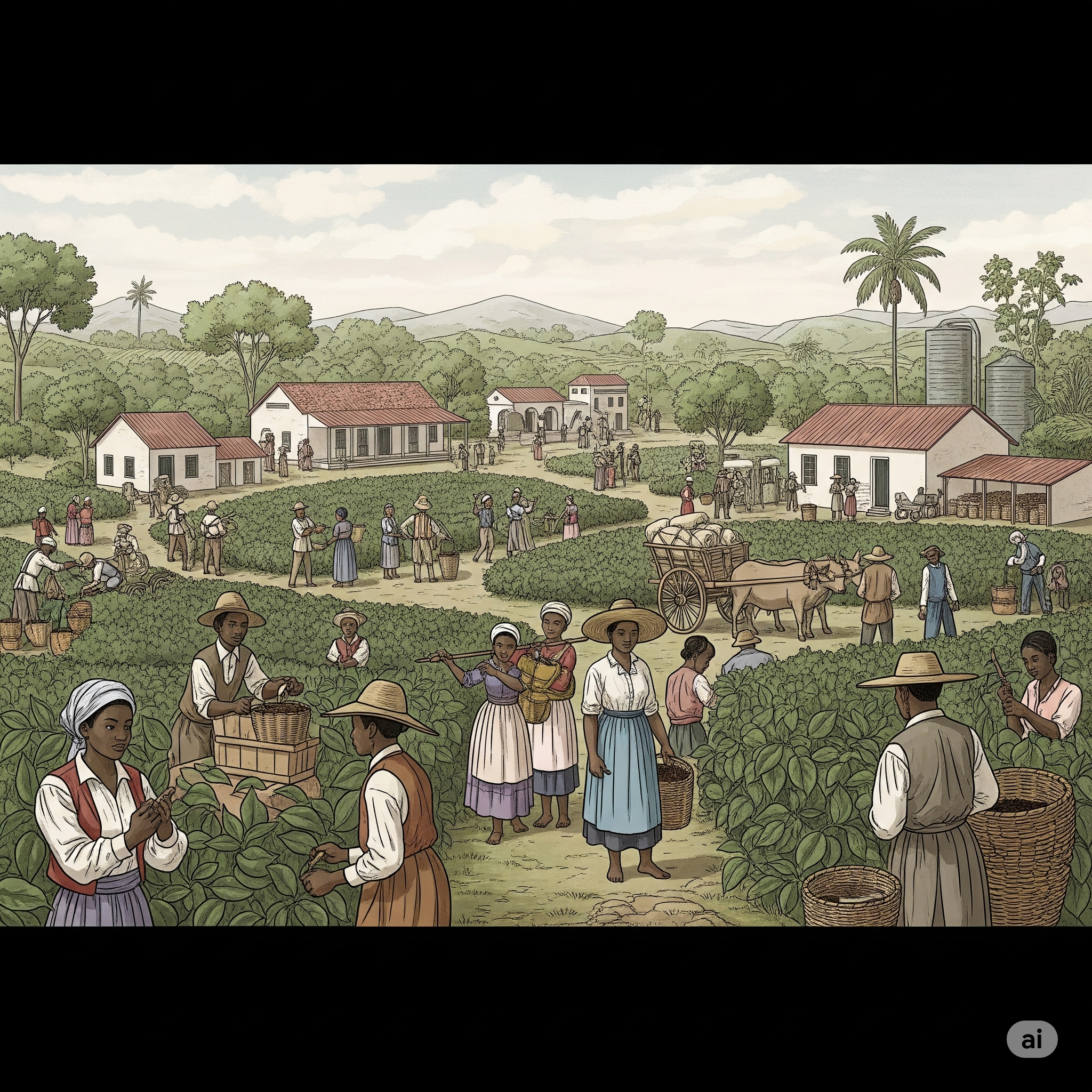
Coffee has been grown and consumed for over a thousand years, starting in the forests of Ethiopia, where legend tells of Kaldi and his energetic goats. From there, coffee spread through Yemen, the Middle East, and eventually into the hands of European traders who introduced it to the Americas, Asia, and the Caribbean during the height of colonial expansion.
⚠️ Colonial Legacies and Coffee:
Coffee was often grown on forced-labor plantations during colonial times.
It replaced native forests in places like Brazil, Vietnam, and Indonesia.
Profits flowed to imperial powers while local farmers were exploited.
Even today, many smallholders in Latin America, Africa, and Asia are trapped in a cycle of debt, low prices, and land insecurity — a legacy of unequal power dynamics.
Fair-trade models directly challenge this paradigm, returning agency and equity to the communities that cultivate coffee.
The Coffee Supply Chain — Why It Matters
Most people don’t realize how complex the journey of a single coffee bean is. Understanding the supply chain helps illuminate where your money goes — and why supporting small farms through direct or fair-trade channels matters so much.
From Seed to Cup: Key Stages
Farming – Coffee is hand-planted, nurtured, and harvested (often manually)
Processing – Beans are washed, fermented, and dried
Milling – Beans are hulled and sorted
Exporting – Often handled by larger middlemen or brokers
Importing/Roasting – Beans are roasted (sometimes locally, sometimes overseas)
Retailing – Final product reaches shelves or your doorstep
In traditional models, small farmers often make less than 10% of the retail price of a bag of coffee. But in fair-trade systems, they can receive 25% to 40% — a dramatic and life-changing increase.
Biodiversity & Coffee: Nature’s Best Allies
Shade-grown farms don’t just grow coffee — they also act as sanctuaries for life. These small ecosystems are vital to combating climate change, supporting pollinators, and restoring threatened species.
Bird-Friendly Farms
The Smithsonian Migratory Bird Center has identified that shade-grown coffee farms:
Host up to 90% more bird species than sun-grown farms
Preserve habitats for endangered species
Provide migratory corridors for birds traveling thousands of miles
Other Benefits to Biodiversity:
Shade coffee farms attract beneficial insects like pollinators and natural predators of pests.
Trees help maintain healthy mycorrhizal fungi in the soil, aiding nutrient cycles.
Canopy layers protect amphibians and reptiles often lost in sun-grown monocultures.
Every time you buy shade-grown coffee, you are helping protect a miniature rainforest on a farm.
💰 The Economics of Ethical Coffee
Some might argue: “Isn’t fair-trade coffee more expensive?” Yes — and here’s why that’s a good thing.
🧾 What Goes Into the Price of Fair-Trade Coffee:
Fair wages for laborers and farmers
Sustainable processing (water conservation, solar drying)
Certifications and inspections
Social premiums for schools, clinics, and infrastructure
In contrast, mass-market coffee often hides externalized costs:
Deforestation
Worker exploitation
Chemical pollution
Carbon emissions from industrial farming
When you pay $4 more for ethical coffee, you’re helping pay off a global debt we owe to farmers and the environment.
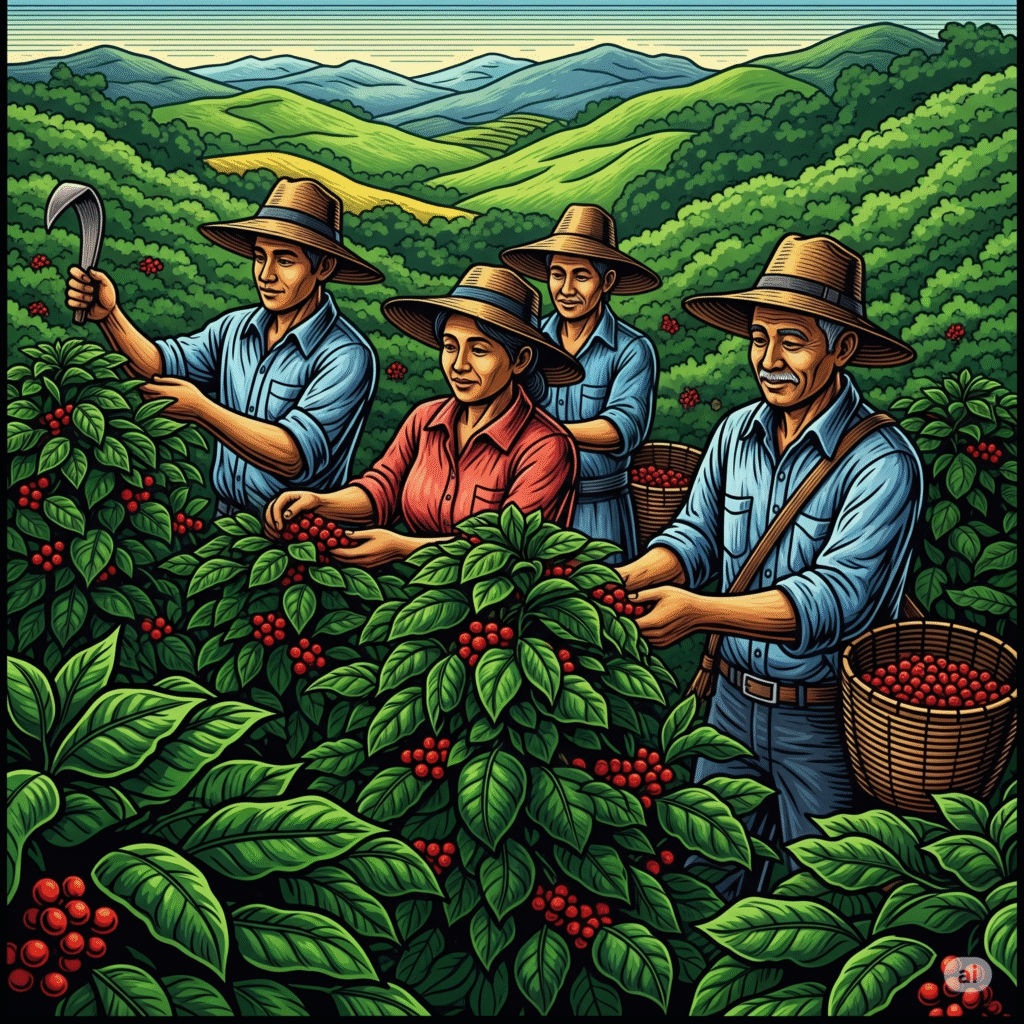
👩🌾 Meet the Farmers: Real Stories Behind the Beans
Let’s go beyond generalities and meet the humans who grow your brew.
Colombia: Coffee Cooperative in Nariño
Farmers in Nariño use agroforestry systems where banana, avocado, and citrus trees provide shade and secondary income. Through fair-trade premiums, they’ve installed solar dryers and community schools.
Ethiopia: Women-Led Farming in Sidama
In Sidama, an all-female collective produces some of the region’s finest washed coffee. With earnings from a fair-trade partnership, they’ve built maternity clinics and funded literacy programs for girls.
Honduras: Organic Shade-Grown Coffee
A farmer in La Paz manages a 2-acre farm that grows under native Inga trees. He earns double the local market rate for his beans and has transitioned to fully organic cultivation thanks to training funded by fair-trade programs.
These stories are not exceptions — they’re examples of what becomes possible when ethical supply chains are in place.
Stats That Show the Impact
Still wondering if your purchase makes a difference? Let’s look at the numbers.
🔹 Fair-Trade Impact:
Over 1.2 million smallholder farmers are part of fair-trade coffee cooperatives globally
$800+ million in fair-trade premiums distributed over the past decade
Communities have built thousands of schools, clinics, and water projects
🔹 Environmental Benefits:
Shade-grown farms sequester up to 70% more carbon than sun farms
Organic methods reduce toxic runoff by 80% or more
Coffee grown in agroforests supports 30–60% more species
Every metric shows that sustainable coffee grows more than beans — it grows hope, equity, and balance.
🚨 The Threat to Small Farms in 2025
Despite growing awareness, many small farms still face serious threats.
🔥 Key Issues:
Climate change is causing unpredictable weather, pests, and disease
Market volatility leaves farmers vulnerable to crashes
Land grabbing and illegal logging endanger protected forests
Lack of youth involvement threatens generational continuity
If these trends continue, the world could lose up to 50% of its suitable coffee-growing land by 2050 — unless we invest in regenerative, community-led solutions now.
Making It Part of Your Lifestyle
Supporting small farms doesn’t have to stop at coffee. You can make ethical sourcing a daily practice.
🛒 Other Items to Buy Fair-Trade:
Chocolate & cocoa
Bananas & sugar
Tea and herbs
Cotton clothing
Handicrafts
🥄 Everyday Rituals:
Pair your fair-trade coffee with a ceramic mug made by a local artisan
Compost your grounds or use them in skincare
Learn about the region your beans came from — it adds cultural richness to your brew
🗣️ What Influencers, Baristas & Experts Say
James Hoffmann, Coffee Author & YouTuber:
“The future of coffee is tied directly to how well we treat the people growing it. If we want specialty coffee to survive, we must value the farmers as much as we value the flavor.”
Vandana Shiva, Environmental Activist:
“Small-scale, diversified agriculture holds the key to sustainability. Fair-trade is not just an economic model — it’s a cultural and ecological necessity.”
Local Barista Perspective:
“When we feature shade-grown coffee in our café, customers often comment on how smooth and flavorful it is. It’s easy to make the switch when quality and ethics align.”
🌡️ Climate Change & Coffee: A Brewing Crisis
Coffee is particularly vulnerable to climate change, and small farms are on the front lines of this unfolding crisis.
🔥 Rising Temperatures, Shrinking Yields
Coffee plants — especially Arabica, which makes up about 60–70% of global production — are extremely sensitive to temperature changes. Even a 1.5°C rise in average temperature can:
Shrink suitable coffee-growing land
Encourage pests like the coffee borer beetle
Disrupt flowering and fruiting cycles
A 2023 study by the Climate Institute predicted that by 2050, half of the world’s coffee-growing regions could become unsuitable.
🌧️ More Rainfall, More Problems
Erratic rainfall, long droughts, and flash floods are becoming common. In places like Honduras and Uganda, farmers are already seeing:
Mold outbreaks and fermentation failures
Crop losses of 30–60% in bad seasons
Loss of entire harvests due to increased fungal diseases like leaf rust
🌱 Shade-Grown Coffee = Climate Resilience
One of the biggest advantages of shade-grown coffee is its ability to buffer extreme weather:
Tree cover maintains microclimates, reducing temperature swings
Root systems prevent erosion and landslides
Diversified crops ensure economic stability if coffee fails
Trees sequester carbon, fighting climate change from the ground up
By supporting shade-grown systems, you’re investing in climate adaptation for the very farmers who feed the global coffee market.
🧠 Debunking Common Myths About Ethical Coffee
There are still many misconceptions that stop consumers from making better coffee choices. Let’s clear the air.
❌ “Fair-Trade Coffee Is Just Marketing”
Fair-trade certification isn’t just a label — it’s a contract between farmers, cooperatives, and buyers. It’s enforced through:
Independent audits
Minimum price guarantees
Community-managed social premiums
Traceable, transparent transactions
Unlike vague claims like “natural” or “ethically sourced,” Fair-Trade Certified coffee has strict global standards.
❌ “Shade-Grown Coffee Doesn’t Taste As Good”
Actually, the opposite is often true. Coffee plants grown slowly in shade develop more complex sugars, leading to:
Richer, deeper flavor profiles
Less bitterness and more balance
Naturally lower acidity in many cases
Many specialty coffee roasters now seek out shade-grown lots for their flavor as much as for their ethics.
❌ “One Purchase Doesn’t Make a Difference”
It’s easy to feel small in a global market. But coffee is a $100+ billion industry. Shifting even 10% of your purchases toward ethical brands can:
Create new demand for fair-trade models
Send price signals to large corporations
Empower co-ops to expand their reach
Your dollar multiplies through the supply chain.
Innovation on Small Coffee Farms
Small farms are not just rustic — they’re incredibly innovative when given resources.
Agroecological Practices Gaining Ground
Many shade-grown farms use regenerative techniques like:
Intercropping with cocoa, bananas, or spices
Composting coffee pulp into fertilizer
Integrated pest management with natural predators
Solar dryers to preserve beans without wood-burning kilns
These practices lower costs, preserve the environment, and yield better tasting coffee — all without synthetic chemicals.
Tech on the Farm
Even remote villages are adopting smart tools:
Mobile apps for tracking harvests and market prices
Low-cost weather stations to warn about drought or floods
Blockchain platforms that trace beans directly to consumers
With fair-trade funds and cooperative support, smallholders are building resilient, tech-savvy farm models — ones that might outlast industrial giants.
The Role of Roasting in Ethical Coffee
While farming practices matter, so does what happens after the beans leave the farm.
Why Roasting Matters
Roasting brings out the flavor, but it can also mask flaws. Ethical roasters tend to:
Use lighter roasts to highlight origin-specific notes
Avoid over-roasting to hide low-quality beans
Tell the story of the farm, not just the blend
Transparency in Roasting
Look for roasters who:
Share roast dates and origin info
Use direct-trade or fair-trade sourcing
Roast in small batches for freshness and quality
These roasters often pay above-market prices, giving farmers an even better return than some larger fair-trade buyers.
🌐 Global Regions to Watch for Ethical Coffee
Not all regions are equally represented in ethical sourcing — here are a few standout areas producing extraordinary shade-grown, fair-trade coffee:
Ethiopia
Home of wild Arabica
Rich biodiversity in regions like Sidama, Yirgacheffe
Cooperatives like OCFCU (Oromia Coffee Farmers Cooperative Union) empower thousands of smallholders
Guatemala
Shade-grown coffee dominates due to mountainous terrain
Regions like Huehuetenango and Antigua produce floral, high-altitude coffees
Farmers face severe climate risk, making support critical
Indonesia (Sumatra, Java)
Known for wet-hulling method and earthy, bold flavors
Many women-led cooperatives
Rainforest Alliance and Bird-Friendly certifications common
Rwanda
Post-genocide recovery through coffee cooperatives
Sweet, tea-like beans with juicy acidity
Strong emphasis on traceability and women-owned farms
Each bag of coffee from these regions often tells a story of resilience, survival, and triumph.
🗺️ Local vs. Global: Why Both Matter
It’s easy to think globally and forget locally. But small coffee businesses near you play a huge role in promoting fair-trade and shade-grown values.
What Local Roasters Can Do:
Source beans from small co-ops
Educate consumers at point of sale
Create economic demand for sustainable beans
Help tell farmer stories more personally
If your local roaster offers transparent sourcing, roast profiles by origin, or seasonal limited lots, they’re likely supporting ethical importers and producers.
Ask them:
“Do you carry any fair-trade or shade-grown coffees?”
This one question can ripple through the entire supply chain.
Navigating Ethical Coffee at the Supermarket
Not every reader shops at specialty cafes — and that’s okay. Here’s how to spot better options even at big-box stores.
✅ Label Guide:
| Label | What It Means |
|---|---|
| Fair Trade Certified | Minimum price paid to farmers, social premium given |
| USDA Organic | No synthetic chemicals used |
| Rainforest Alliance | Environmental sustainability focus |
| Bird-Friendly | Verified shade-grown and organic |
| Direct Trade | Often higher pay than fair-trade, but unregulated |
Pro tip: Choose brands that list:
Origin region (not just “South America”)
Roast date (not expiration)
Sourcing transparency (look for a URL to farm data)
How Big Brands Are (Slowly) Catching On
Ethical coffee is no longer niche — even big brands are jumping on board.
Notable Moves:
Starbucks has committed to 100% ethically sourced coffee, though its internal standards are weaker than Fair Trade Certified
Nespresso launched its AAA Program with traceability and direct trade components
McDonald’s and Dunkin’ offer Rainforest Alliance-certified options
But many still rely on minimum standard practices that don’t match true fair-trade values. That’s why consumer awareness is crucial.
By choosing brands that go beyond the minimum, you raise the bar for the entire industry.
🧩 The Bigger Picture: Coffee & Social Justice
Coffee isn’t just about agriculture — it intersects with issues of:
Racial and economic inequality
Land ownership and indigenous rights
Women’s empowerment
Sustainability and global trade fairness
Supporting small farms means:
Uplifting BIPOC farmers around the world
Protecting land from corporate exploitation
Supporting women-led co-ops that reinvest into education and health
Investing in models that don’t exploit labor or land